We’ve already covered two outcomes from this year’s WHO Regional Committee for Africa session: the Africa Health Workforce Agenda and the broader ministerial gathering itself. A third framework adopted at the same session addresses something less visible but arguably just as consequential: what happens to polio’s infrastructure now that polio itself is mostly gone.
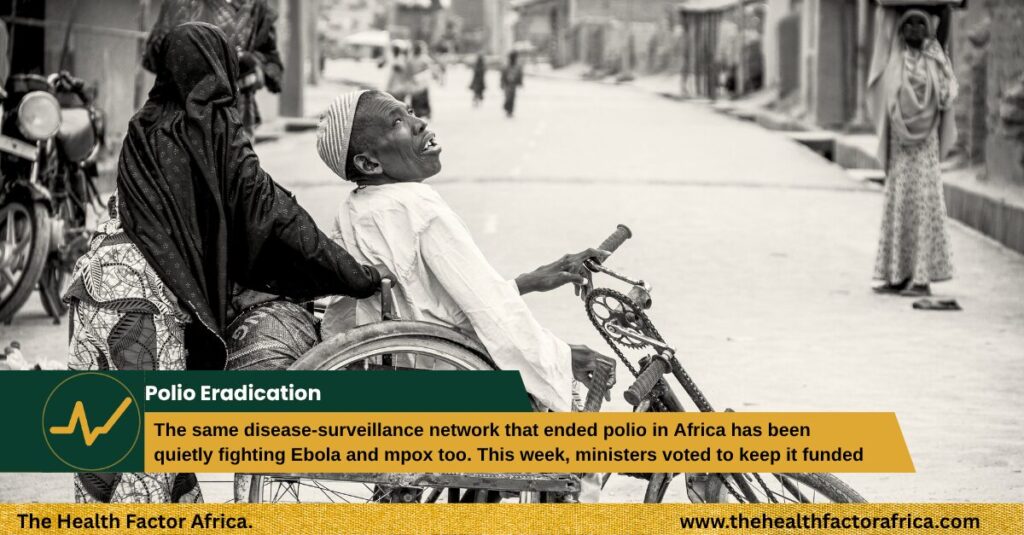
Ministers adopted the Framework for Polio Transition and Sustainability in the WHO African Region 2026-2035, a 10-year plan to protect the surveillance systems, laboratories, emergency response networks, and trained workforce built over decades of polio eradication work. Africa was certified free of indigenous wild poliovirus in 2020, but the region has recorded more than 180 polio detections in 2026 alone, concentrated in the Lake Chad Basin and Horn of Africa, meaning the infrastructure built to fight it is still actively needed.
Here’s the connection worth making explicit: polio-funded personnel and infrastructure have repeatedly been redeployed well beyond polio itself, supporting responses to Ebola, Marburg virus disease, mpox, cholera, and yellow fever, the exact outbreaks we’ve tracked in DRC, Guinea-Bissau, and across West and Central Africa this year. When we wrote about surveillance gaps letting DRC’s Ebola outbreak spread undetected for months, this is the kind of standing capacity that closes that gap, when it’s funded and maintained.
The framework’s core bet is that as dedicated polio eradication funding declines, countries need to institutionalise these functions into their national health systems rather than let them quietly disappear. WHO’s Dr. Mohamed Gedi tied this directly to broader health security: sustained surveillance and outbreak preparedness capacity protects countries against threats well beyond polio.
What You Can Do
- Understand that “eradication” doesn’t mean the infrastructure can be switched off. This framework exists precisely because the surveillance and lab networks remain useful long after the disease they were built for is gone.
- Watch how individual countries fund this transition domestically. The framework’s success depends on national governments actually institutionalising these functions, not just endorsing the plan.
This article is for general information on a regional policy framework. For country-specific polio transition plans, consult WHO Regional Office for Africa directly.
The Health Factor Africa
Want the Policy Brief version?
Every explainer gets a shorter, policy-focused brief in your inbox — built for people who need the decision-relevant version fast.