We’ve spent weeks explaining how gutted surveillance funding let DRC’s Ebola outbreak circulate undetected for months before anyone caught it. This week’s story out of Nigeria is a useful counterpoint: what it looks like when that same kind of infrastructure gets built up instead of stripped away.
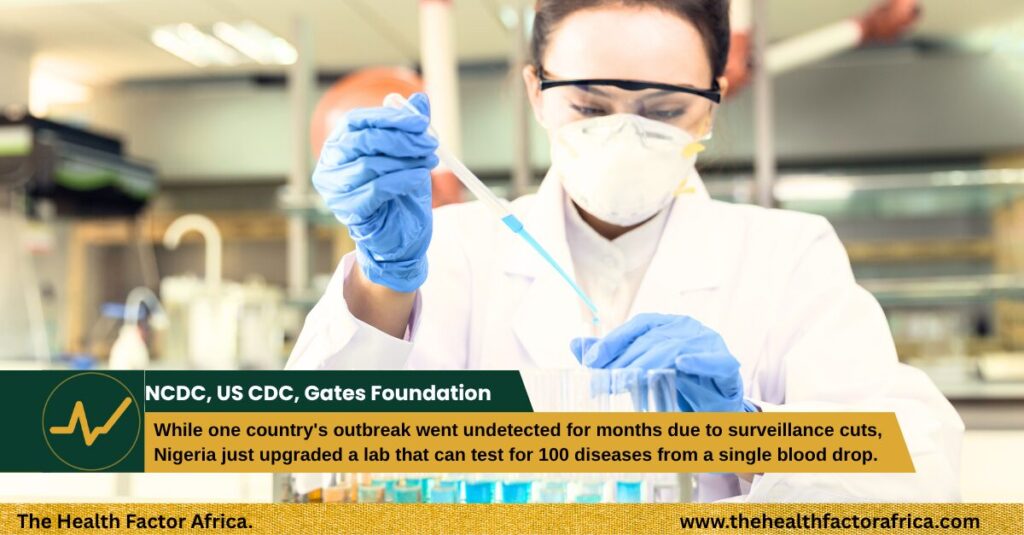
The Nigeria Centre for Disease Control and Prevention, with support from the US CDC, CDC Foundation, and Gates Foundation, has been developing a Multiplex Bead Assay (MBA) Laboratory at its National Reference Laboratory in Abuja. The technology itself is genuinely powerful: it can test simultaneously for up to 100 different disease markers from a single dried blood spot, instead of running separate tests for each disease, a major advantage in cost, speed, and how much can be learned from one sample.
This isn’t a new or untested system. Since instruments were installed in 2019, the lab has tested an estimated 130,000 people through the Nigeria HIV/AIDS Indicator and Impact Survey, completed two rounds of COVID-19 serosurveys, and validated Nigeria’s own SARS-CoV-2 assays rather than relying entirely on imported standards. Researchers have also used it to study population-level immunity to malaria.
What’s new: a team of US CDC experts just spent two weeks at the MBA lab in Lagos specifically transferring skills in “bead coupling technology,” the process of actually building the assay components Nigerian scientists use, rather than only running kits made elsewhere. That’s a meaningful upgrade, echoing the same local-capacity argument we traced in Africa’s pharmaceutical bioequivalence testing gap: real self-reliance means being able to make the tools, not just operate them.
The West Africa hub goal isn’t just aspirational language, either. The Gates Foundation formally committed funding in December 2024 specifically for a “Multiplex Bead Assay Serosurveillance Regional Hub Project and South-to-South Technology Transfer” based in Nigeria, meaning this month’s skills transfer sits inside an actual multi-year, funded initiative rather than a one-off lab visit.
What You Can Do
- If you’re in public health or laboratory science in Nigeria, this kind of serosurveillance capacity is exactly the infrastructure layer that determines how fast future outbreaks get caught, worth following as it scales.
- Support continued investment in surveillance infrastructure specifically, not just outbreak response after the fact. This week’s story is a rare example of that investment actually happening.
This article is for general information on Nigeria’s public health laboratory infrastructure. For more on NCDC’s surveillance programmes, visit ncdc.gov.ng directly.
The Health Factor Africa
Want the Policy Brief version?
Every explainer gets a shorter, policy-focused brief in your inbox — built for people who need the decision-relevant version fast.