This year alone, we’ve covered an Ebola outbreak in DRC spreading faster than health workers can track it, a cholera crisis moving across six countries along two river systems, a bioequivalence testing gap threatening trust in Africa’s own manufactured medicine, and a US health financing deal requiring Nigeria to cofinance more than its own budget growth may realistically support. Each felt like its own isolated story. Africa CDC just named the thread connecting all of them, and built its flagship conference around it.
What CPHIA Actually Is
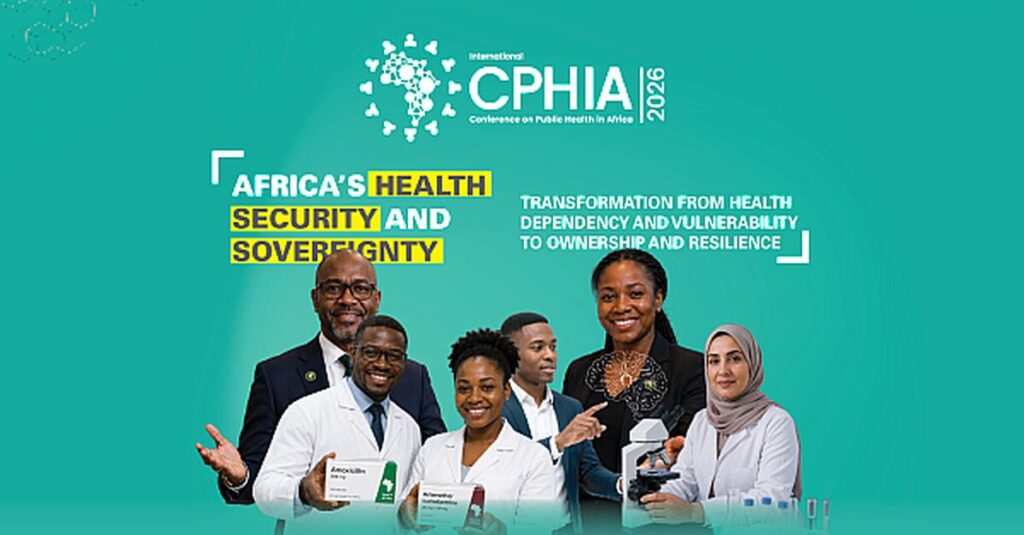
The 5th International Conference on Public Health in Africa (CPHIA 2026) will be convened by Africa CDC from November 23 to 27, 2026. This week, Africa CDC opened its call for abstract submissions and for experts to apply as abstract reviewers, the two channels that will shape what evidence and research actually gets discussed on stage. Africa CDC Director General Dr. Jean Kaseya framed the stakes plainly: “Africa is defining the public health future it wants.”
The Theme Is the Whole Story
CPHIA 2026’s official theme is “Africa’s Health Security and Sovereignty: Transformation from Health Dependency and Vulnerability to Ownership and Resilience.” Read against this year’s actual events, it stops sounding like a conference slogan and starts sounding like a direct response to specific, recent failures: outbreaks moving faster than surveillance systems can follow, medicine manufacturing that still depends on outsourced quality testing, and health financing structured around what outside partners are willing to fund rather than what countries can sustainably co-invest.
What “Ready to Lead” Actually Covers
The conference is organized around four stated pillars: Ready to Lead, Ready to Respond, Ready to Protect, and Ready to Prevent. In practice, that means bringing political leadership into direct conversation with scientists, health workers, young people, civil society, and the private sector, with an explicit focus on moving past commitments and communiqués toward the actual systems, investments, and capabilities needed to back them up, precisely the gap we’ve seen play out repeatedly this year between announcements and implementation.
How Nigerians Can Actually Participate
This isn’t a conference to just read about after the fact. Africa CDC is actively inviting researchers, scientists, public health practitioners, and implementers, from Nigeria and across the continent, to submit abstracts bringing forward new evidence, innovations, and field experience. Qualified experts can also apply to serve as reviewers, shaping which research actually makes it onto the programme. Professor Yemane Berhane, Co-Chair of the CPHIA 2026 Scientific Programme Committee, put the underlying goal directly: “Africa is producing knowledge, evidence and innovation” that should increasingly shape the continent’s own health decisions, rather than being shaped by evidence generated elsewhere. Both the abstract submission and reviewer application windows close on September 15, 2026.
Why This Matters Beyond the Conference Room
A conference theme doesn’t fix an outbreak or lower a premium. But CPHIA has real influence on where continental attention, funding conversations, and policy pressure land over the following year. If 2026’s pattern, real capability paired with real gaps, is going to shape what gets prioritized next, this is one of the few rooms where that argument gets made directly to the people who can act on it.
What You Can Do
• If you’re a Nigerian researcher, clinician, or public health practitioner with relevant work, consider submitting an abstract before the September 15 deadline. Africa CDC explicitly wants field-level implementation experience, not just academic research.
• If you have relevant expertise, apply to serve as a reviewer. The review process directly shapes what evidence gets prioritized at the conference.
• Follow CPHIA’s build-up over the coming months. Africa CDC has said further announcements on speakers and programming will follow, and the themes will likely track closely with the stories already shaping this year’s headlines.
The Health Factor Africa
Get verified health news, free
One email a week: explainers, myth-checks, and the stories behind the headlines.
Work in health policy, government or an NGO? Get the monthly Policy Brief instead.