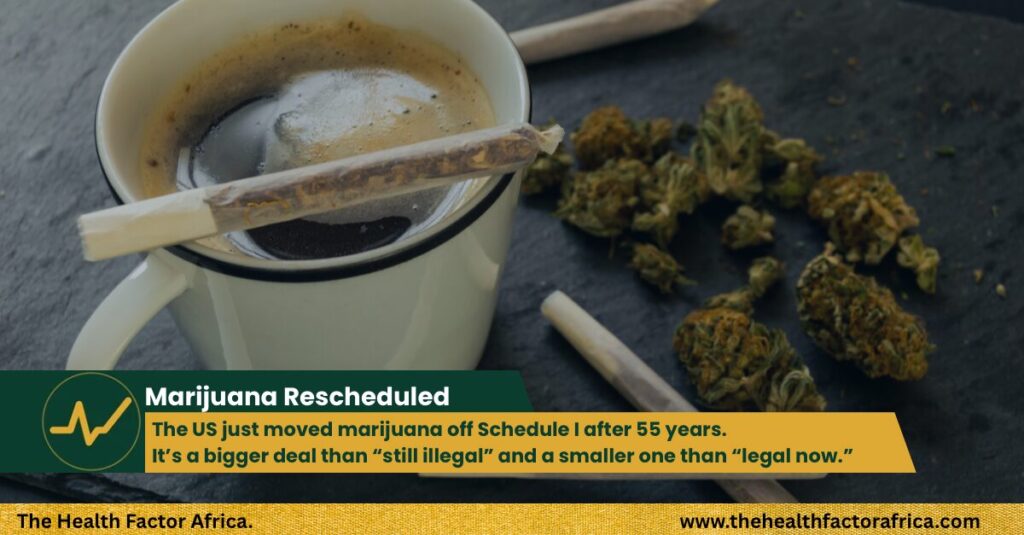
We’ve already covered the contrast between America’s growing daily cannabis use and Nigeria’s 15-years-to-life penalties for the same plant. That comparison just got more complicated. In April, the US federal government made its biggest change to marijuana policy in over five decades, though not the change most headlines implied.
What Actually Happened
On April 23, 2026, the US Department of Justice and Drug Enforcement Administration issued a final order moving certain categories of marijuana from Schedule I to Schedule III of the Controlled Substances Act, acting on an executive order President Trump signed in December 2025. It’s the first change to marijuana’s federal classification since the Act took effect in 1970.
What Schedule I Versus Schedule III Actually Means
Schedule I is reserved for substances the federal government considers to have high potential for abuse and no accepted medical use, the same category heroin and LSD occupy. Schedule III covers substances with lower abuse potential and recognized medical use, alongside drugs like ketamine and anabolic steroids. Moving something between these categories is a statement that the government now formally recognizes medical value it previously denied outright.
What This Does Not Do
Here’s where most social media summaries oversimplify. This is not federal legalization of marijuana. The order applies narrowly to two categories: marijuana-derived products that are FDA-approved, and marijuana produced and dispensed through a state’s official medical marijuana licensing programme. Everything else, including all recreational marijuana and any marijuana outside a state medical licensing structure, remains a Schedule I substance under federal law, exactly where heroin and LSD still sit. Interstate sales remain restricted, and marijuana businesses must still navigate both state and federal registration requirements. Hemp and synthetic THC status are unaffected entirely.
The Practical Consequences That Actually Matter
Two changes carry real weight. First, state-licensed medical marijuana businesses are no longer subject to Section 280E of the federal tax code, a rule that previously barred Schedule I and II drug businesses from deducting ordinary business expenses, a change that meaningfully improves the finances of legal medical operators. Second, researchers can now obtain cannabis products from federally registered, state-licensed suppliers, letting them study products that actually resemble what patients use, instead of relying solely on government-grown research-grade cannabis that often doesn’t match real-world products.
What’s Coming Next
The order also set up an expedited DEA administrative hearing beginning June 29, 2026, to formally consider whether marijuana should be reclassified more broadly, beyond just FDA-approved and state-licensed medical products. That hearing, not April’s order, is where a genuine shift toward wider federal change would actually happen. Nothing about broader recreational marijuana’s federal status has been decided yet.
Why This Complicates the Nigeria Comparison
Our earlier piece contrasted America’s rising daily cannabis use with Nigeria’s harsh criminal penalties for the same substance. This update adds a layer worth sitting with: even after this reform, the US federal government still fully criminalizes recreational marijuana, the very use driving most of that daily-use statistic. The real story isn’t “America legalized weed while Nigeria didn’t.” It’s that both countries have a gap between what their laws say and what’s actually happening on the ground, just shaped differently. America’s gap is between federal law and state-level normalization. Nigeria’s gap is between blanket prohibition and an estimated 11 million existing users the law doesn’t acknowledge.
What You Can Do
• Don’t assume US marijuana is now federally legal. Recreational use remains a federal Schedule I offense regardless of state law.
• If you’re researching cannabis policy for any purpose, distinguish carefully between FDA-approved products, state-licensed medical marijuana, and recreational marijuana. Each sits in a different legal category after this order.
• Watch the June 29, 2026 DEA hearing outcome. It’s the actual decision point for whether US federal policy shifts further
The Health Factor Africa
Get verified health news, free
One email a week: explainers, myth-checks, and the stories behind the headlines.
Work in health policy, government or an NGO? Get the monthly Policy Brief instead.