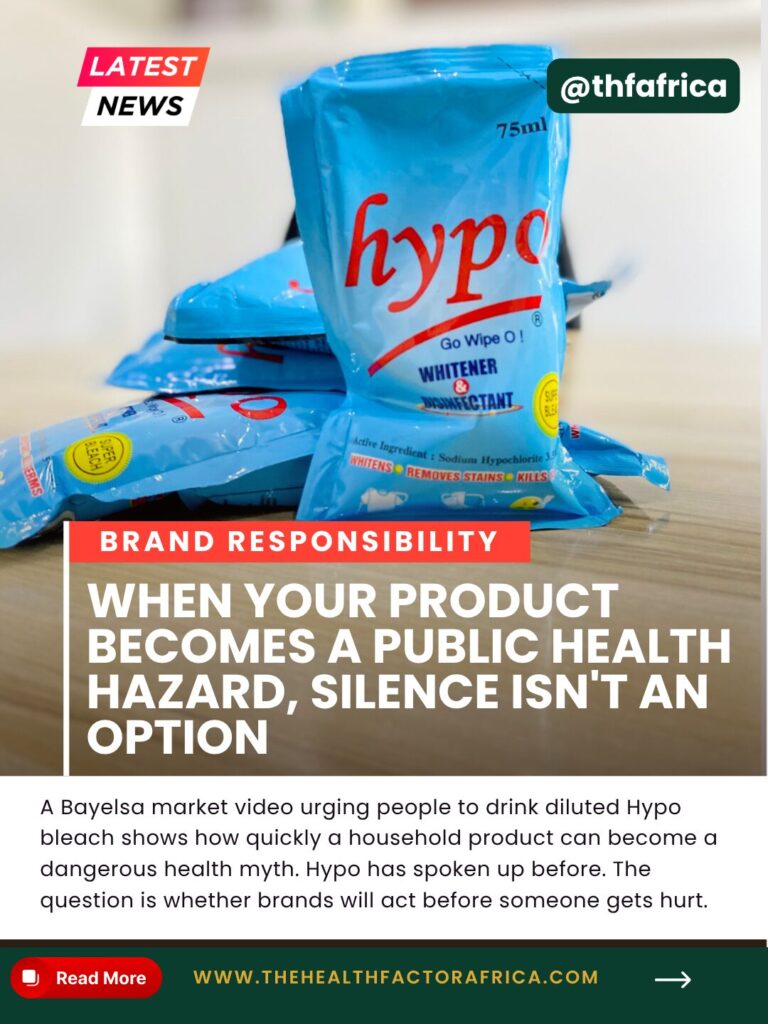
In a busy Bayelsa market, a man holds up a sachet of Hypo bleach and tells traders it kills intestinal germs when taken in diluted form. Some listen. The video spreads.
Bleach is made to clean surfaces. Swallowed, even diluted, it can burn the mouth, throat and stomach and can kill. It cures nothing.
THF Africa could not find any public response from Hypo to this video. That matters, because Hypo knows how to respond.
A brand that has done it before
On March 1, 2026, Hypo issued a statement condemning a social media trend that showed its bleach as a drink, sparked by a stunt involving influencers VDM and King Mitchy. The brand said its product is only for removing stains and disinfecting surfaces, and told young creators that “no trend is worth your life.”
That was the right call. The Bayelsa claim is arguably more dangerous because it is not a joke. It is sincere health advice, given to people who may act on it.
What responsible brands do
Hypo is not alone. In 2020, when a US president mused about using disinfectants inside the body, Reckitt, maker of Dettol and Lysol, and Clorox warned the public the same day that their products must never be swallowed or injected. In 2018, Procter & Gamble fought the “Tide Pod Challenge” with a video featuring American football star Rob Gronkowski.
Their reasoning was simple: when a product is misused in ways that can kill, the brand’s voice reaches people regulators cannot.
Why Nigeria needs more of this
From bleach to insecticides like Sniper, whose misuse pushed NAFDAC to restrict sales, Nigerian households are full of products that can harm when misused. Clear labels in local languages, quick responses to viral misinformation and partnerships with health communicators can save lives.
Silence is not neutrality. When a dangerous claim about your product goes viral, saying nothing lets the myth do the talking.
The Health Factor Africa
Get verified health news, free
One email a week: explainers, myth-checks, and the stories behind the headlines.
Work in health policy, government or an NGO? Get the monthly Policy Brief instead.