We recently covered a gold mine landslide in Central African Republic that killed more than 100 artisanal miners. This week’s reporting from South Africa’s Free State shows the health cost of informal gold mining even when nothing collapses.
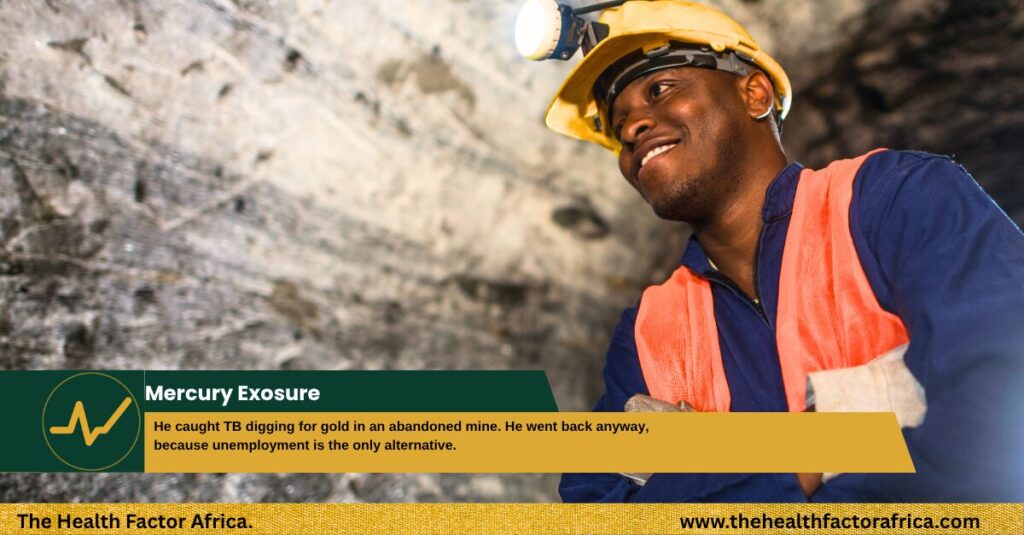
Thabo, 48, spends his nights digging around old mine rock dumps between Nyakallong and Allanridge, one of an estimated 34,000 to over 50,000 informal miners, known as zama zamas, working South Africa’s roughly 6,100 abandoned or improperly sealed mines. He contracted tuberculosis in 2025, unsurprising given the documented occupational risk: a 2021 National Institute for Occupational Health study of 546 deceased gold miners found roughly one in seven had active TB and more than one in five had silicosis, a lung disease caused by inhaling silica dust. “The work we do is a health hazard,” Thabo says. “We work in a place full of dust and sometimes use sewage water to drain and wash our material.”
Mercury adds a second, more acute risk. Informal miners use it to bind and extract gold from raw material, then heat the resulting amalgam, releasing mercury vapour that can be inhaled without protection, with documented effects on the nervous system, lungs, and kidneys. One miner, Katleho, suffered chemical burns and a rash requiring two weeks of hospital treatment; another, Kamohelo, never sought medical care for his chemical burns at all, treating them at home with toothpaste.
Researchers and organisers point to the same underlying cause: corporate mine abandonment combined with poverty and unemployment. The advocacy group MACUA has begun running safety workshops in the area, distributing masks and gloves to about 50 miners so far and explaining their rights under South Africa’s Mineral and Petroleum Resources Development Act. Labour groups are separately calling for low-grade abandoned mines to be formally licensed to regulated artisanal cooperatives, which would bring miners under safety oversight rather than leaving them entirely outside it. For Thabo, the calculation remains simple: “I know mining itself is destructive and intrusive, but what can one do when you are unemployed and hungry? At least when you get sick you can go to the doctor or a clinic, but there is no humiliating thing such as hunger.”
What You Can Do
- If you work in informal mining, prioritise basic protective equipment where you can get it, masks specifically reduce silica dust inhalation risk, one of the clearest documented drivers of TB and silicosis in this work.
- Seek medical care for chemical burns and persistent respiratory symptoms rather than treating them at home. Mercury exposure and silica-related lung disease both require proper diagnosis and treatment.
- Support calls for regulated artisanal mining cooperatives. Bringing informal miners into a licensed system is the most concrete proposal on the table for actually reducing these risks.
This article is for general information. If you are experiencing respiratory symptoms, chemical burns, or suspect mercury exposure, seek medical care at the nearest health facility immediately.
The Health Factor Africa
Get verified health news, free
One email a week: explainers, myth-checks, and the stories behind the headlines.
Work in health policy, government or an NGO? Get the monthly Policy Brief instead.