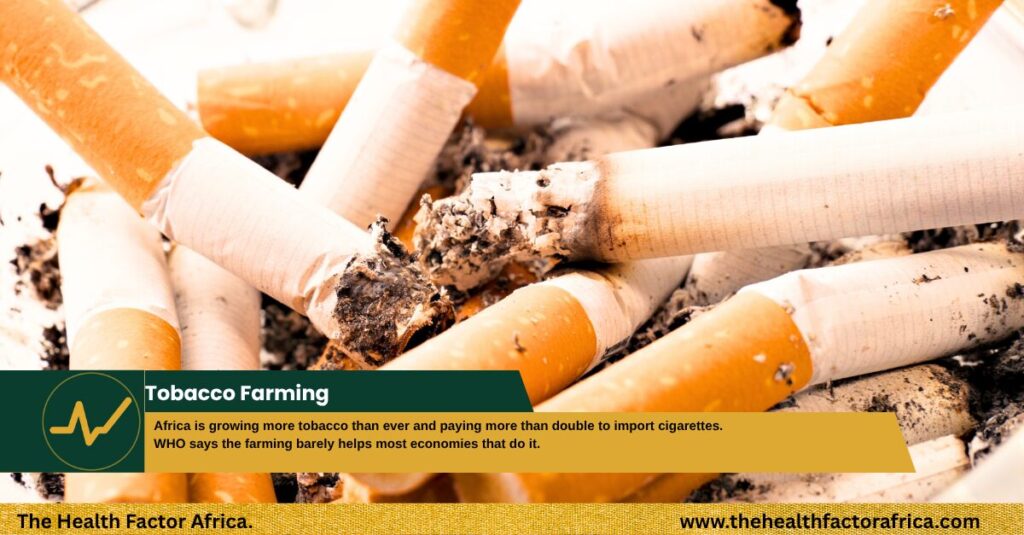
We’ve covered the fight over Nigeria’s tobacco control amendment bill and the loopholes critics say it opens for youth marketing. This week’s WHO analysis adds an economic angle worth knowing: Africa is growing more tobacco than ever, while simultaneously spending more to import the cigarettes made from it elsewhere.
Global tobacco-leaf production fell nearly 19% between 2012 and 2024. Africa’s rose almost 9% over the same period, concentrated largely in Zimbabwe, Malawi, Tanzania, Mozambique, and Uganda, with East Africa alone accounting for nearly 90% of the continent’s output. At the same time, Africa’s cigarette import bill more than doubled, from $833 million to $1.77 billion.
WHO’s Dr. Vinayak Prasad framed this bluntly: “this is not just a tobacco-control issue. It is a health, trade, development and environmental issue.” The health cost falls on farmers directly: exposure to green tobacco sickness (nicotine absorbed through skin from wet leaves), pesticides, and tobacco dust, alongside soil degradation and deforestation from the curing process. In some countries, children from poor farming families miss school to support the work.
Here’s the finding that challenges the usual justification for tobacco farming: WHO says tobacco-leaf exports contribute more than 1% of GDP in only a few African countries, Zimbabwe and Malawi among them, undercutting the argument that tobacco production is economically essential across the continent. WHO is calling on governments to help farmers transition to alternative livelihoods while strengthening tobacco-control measures generally.
What You Can Do
- If you’re a tobacco farmer, know that WHO and the Framework Convention on Tobacco Control specifically call for support transitioning to alternative crops; ask local agricultural extension services about available programmes.
- Support tobacco-control policy that considers farmers, not just consumers. The economic case for tobacco farming is weaker than commonly assumed in most producing countries.
This article is for general information based on WHO analysis. For tobacco farming transition support, contact your national agricultural ministry.
The Health Factor Africa
Get verified health news, free
One email a week: explainers, myth-checks, and the stories behind the headlines.
Work in health policy, government or an NGO? Get the monthly Policy Brief instead.