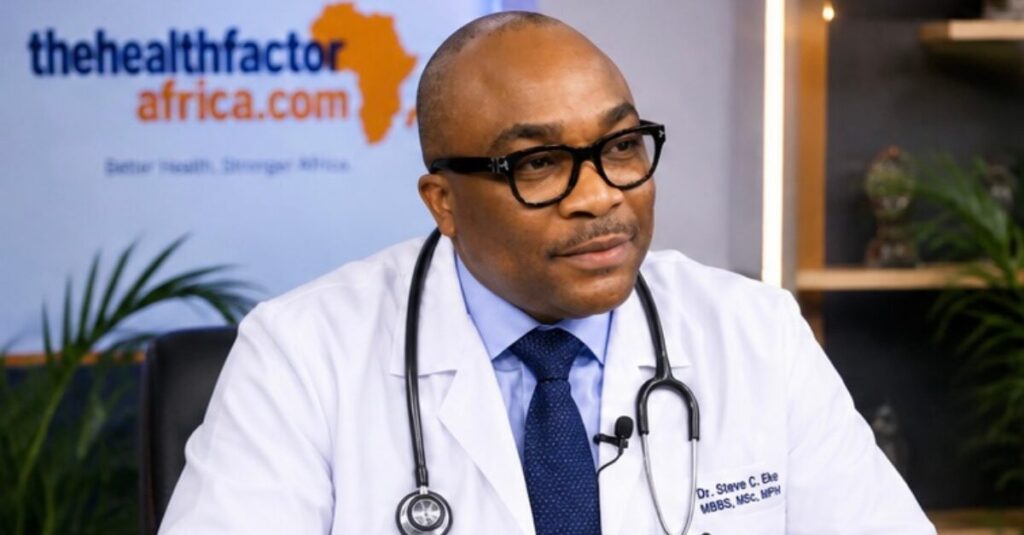
This is Part 2 of a three-part THF Africa series drawn from an exclusive interview with Dr. Steve C. Eke, a Nigerian-trained physician now practicing in the United States. Part 1 examined the diaspora-return debate. This installment looks at Nigeria’s health budget and infrastructure spending. Part 3 covers disease surveillance and epidemic preparedness.
Nigeria’s proposed 2026 federal budget allocates about N2.48 trillion to health out of a total N58.47 trillion, roughly 4.2% of total spending. It’s the highest nominal health allocation in the country’s history, and the Minister of Health, Muhammad Pate, has said the government is working to push that figure closer to 6%. Even so, it remains far short of the 15% threshold Nigeria and other African Union member states committed to under the 2001 Abuja Declaration, a target the country has never met in more than two decades.
For Dr. Steve C. Eke, a Nigerian-trained physician (MBBCh, University of Calabar) now practicing in the United States, the shortfall in funding is only half the story.
“A country cannot be, the number of people that we are, over 250 million and counting, the GDP that we have, and budget that sum to healthcare,” he told THF Africa. “It’s an embarrassment. It tells you the government itself is not interested in raising the healthcare situation of the country.”
When Budget Meets Building, and Nothing Else
Dr. Eke’s sharpest example comes from his own state, Imo, where a large hospital was built on Owerri-Aba Road under then-governor Rochas Okorocha, with what he describes as “endless resources of the state pumped into it without an assessment of needs.”
“They went ahead largely just so that they could spend money,” he said. “Built an ultra-modern hospital, not a single doctor to run it. When the place was commissioned, it stayed open, all the equipment were bought, nothing happened.” Eventually, he said, the state handed the facility over to the Nigerian Air Force.
It no longer functions as a hospital at all.
He draws a direct line to his own early career. Posted to Kirfi Local Government Area in Bauchi State for his National Youth Service Corps year, where his professional record shows he served as Medical Officer in charge of a 25-bed cottage hospital from 2001 to 2002, Dr. Eke found a facility built in 1981 that had sat essentially unused for nearly two decades. “Many of the equipment were still in nylon wrappings, never been used. The rooms never been opened. The beds never been set up,” he said. He was, by his account, the first doctor to stay in that local government for the full length of a posting rather than rotate out.
“You’re putting money to where there’s no personnel,” he said. “To build a hospital doesn’t guarantee healthcare. Healthcare is guaranteed by healthcare personnel. That’s why we’re able to do anything, even under the tree, even when the environment is not conducive.”
A Needs Assessment for Every Naira
Dr. Eke’s central prescription is procedural. Every health expenditure, he argues, should be preceded by a documented assessment of need, a standard he says is routine in the systems he now works in, and largely absent in Nigeria’s.
“Every single time one dollar is spent in Nigerian healthcare, there’s a needs assessment to justify both the necessity and the implementation and the sustainability of such a program. That’s how it’s done everywhere else,” he said. Without it, he argues, health spending becomes vulnerable to political capture, with contracts and appointments driven by loyalty rather than public health outcomes. “It’s not a jamboree free-for-all where you call your friend because he donated two million dollars to you for election to come and be Minister of Health.”
He extends the same logic to primary care investment broadly, arguing that Nigeria’s health spending skews toward visible, elite-facing projects at the expense of the diseases actually killing the most people. “More people are dying from preventable diseases than they are from cancers,” he said. “For every one of that person, a hundred more have died from preventable diseases. Until we recognize that as a bottom-up approach in healthcare, versus just picking the elite and trying to deal with their concerns, we will not be able to find our footing.”
Regulation Gaps: The Case of Illegal Pharmacies
The conversation also touched on a recent enforcement action in Cross River State, where regulators shut down roughly 500 illegal pharmacies in Calabar alone. Dr. Eke was unsurprised.
“I’m sure it’s only peculiar to Calabar? I’m sure it’s everywhere in the country,” he said. “The reasons why we have illegal structures or illegal facilities sprouting up from every corner of the country is what we really need to investigate.” He pointed to a basic regulatory question that he says should already have an answer: whether the Ministry of Health agencies responsible for licensing pharmaceutical production and distribution are adequately staffed, funded, and empowered to do that job, describing it as a structural failure, not a mystery.
What He’d Tell the Government
Asked directly what advice he would give the president on preparing the health system to receive returning diaspora doctors, Dr. Eke’s answer was blunt: fix the incentive structure before issuing the invitation.
“Number one thing: allocate more money in your budget for healthcare, period,” he said. “Number two, ensure that the healthcare of states and regions are run along policies that do not truncate [with changes in political leadership]. Healthcare should not be politicized. Never.”
His benchmark for what “enough” would look like is steep, a healthcare allocation of up to 20% of the national budget, which he describes as “the minimum that is acceptable anywhere in the world.” Nigeria’s current trajectory, moving from roughly 4.2% toward a stated goal of 6%, remains a fraction of that.
Dr. Eke has served as Clinic Medical Director at the Urgent Care Clinic in Cartersville, Georgia, since 2016, and is CEO/co-founder of Doctors of Charity, Incorporated, a US-based nonprofit he has led since 2009. This interview has been condensed and lightly edited for clarity.
Read the full series:
Part 1: You’re Asking Me to Trade Stability for Uncertainty
Part 2: Building Hospitals Isn’t Building Healthcare (this article)
Part 3: Surveillance Is the Key, Not Clinical Practice
The Health Factor Africa
Get verified health news, free
One email a week: explainers, myth-checks, and the stories behind the headlines.
Work in health policy, government or an NGO? Get the monthly Policy Brief instead.