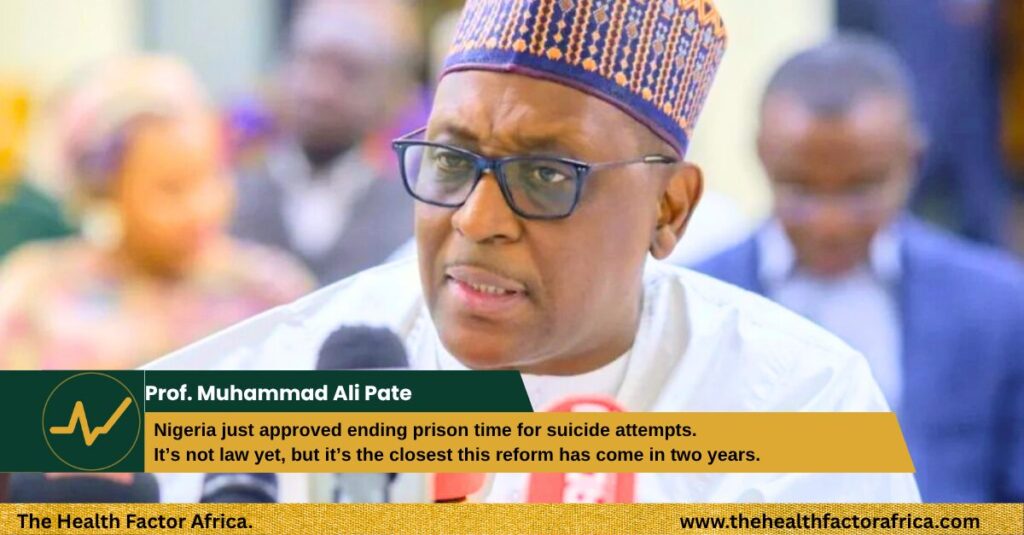
The Federal Executive Council has approved an amendment to Nigeria’s National Mental Health Act that would decriminalise attempted suicide, Coordinating Minister of Health and Social Welfare Prof. Muhammad Ali Pate announced this week. The amendment now moves to the National Assembly for legislative consideration, meaning it isn’t law yet, but it’s the furthest this specific reform has advanced.
The change addresses a direct contradiction in Nigerian law. Attempted suicide is currently a criminal offence under colonial-era provisions, Section 327 of the Criminal Code Act in southern states and Section 231 of the Penal Code in the north, both allowing up to a year’s imprisonment for someone who survives an attempt. Yet the National Mental Health Act 2021 already calls for supportive care, protection, and treatment for people at risk of self-harm. Pate’s point was that Nigeria has effectively been running two contradictory legal responses to the same crisis: one offering care, one offering prison. Lagos State already treats attempted suicide differently, as a matter requiring hospitalisation rather than criminal punishment, showing how inconsistent the current patchwork already is.
This builds on more than two years of groundwork: a National Taskforce established in October 2024, a stated commitment to present the change as an Executive Bill by September 2025, and a December 2025 deadline that came and went before this week’s actual FEC approval. Nigeria’s suicide rate is estimated at 12.9 per 100,000, and suicide is the fourth leading cause of death among Nigerians aged 15 to 29. WHO estimates that for every death by suicide, roughly 20 more people attempt it.
What’s still missing is passage through the National Assembly, and the funding to back it up, NHIA’s chairman has separately pushed for a dedicated ₦4 billion mental health fund in the 2026 budget. A law without services behind it changes little for someone in crisis today.
What You Can Do
• If you’re a health worker, know the legal shift signals a coming change in how attempted suicide should be handled clinically, not just criminally, even before the National Assembly finalises it.
• Push for the ₦4 billion mental health fund and National Assembly passage to be tracked as closely as this week’s approval was.
The Health Factor Africa
Get verified health news, free
One email a week: explainers, myth-checks, and the stories behind the headlines.
Work in health policy, government or an NGO? Get the monthly Policy Brief instead.