We covered the Africa Primary Health Care Forum’s core argument a few weeks ago: Africa’s health future gets decided at the clinic down the road, not the biggest hospital in the capital. This week, that argument won $3 million and the world’s largest annual humanitarian award.
What Last Mile Health Actually Does
Last Mile Health, based in Accra, Ghana, is the 2026 recipient of the Conrad N. Hilton Humanitarian Prize, which comes with $3 million in unrestricted funding. According to the Hilton Foundation, the organization supports more than 20,000 professional community health workers across Ethiopia, Liberia, Malawi, and Sierra Leone, and has helped provide primary healthcare to more than 32 million people. Its defining feature isn’t running its own parallel clinics. It partners directly with government health systems, equipping community health workers already embedded in their communities with the training and resources to deliver essential care.
What “Last Mile” Actually Means in Practice
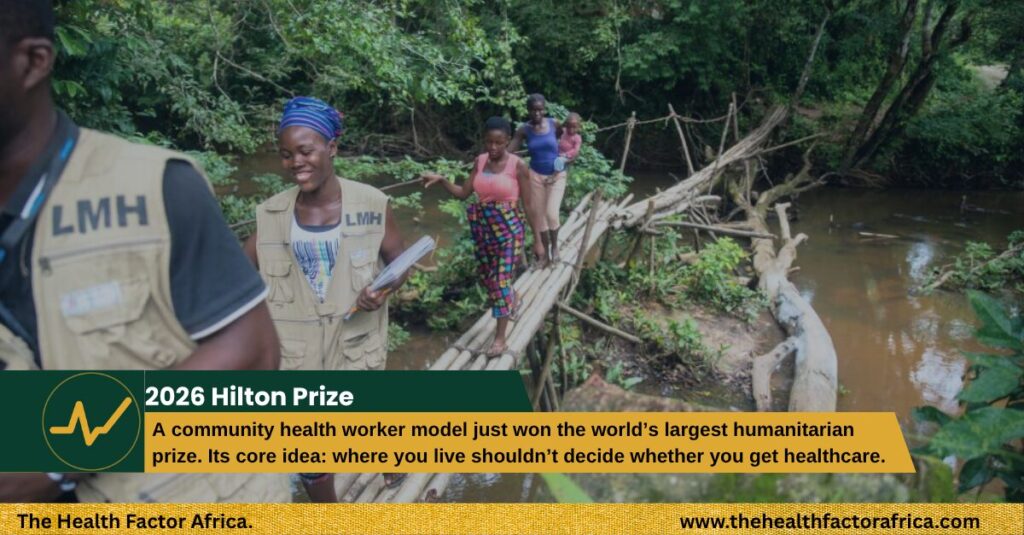
In Liberia, nearly 30% of the population lives more than five kilometers from the nearest health facility. Since 2007, Last Mile Health has worked with Liberia’s Ministry of Health to build a community health workforce that crosses footbridges and canoes rivers to reach people who would otherwise go without care, now covering every county in the country. Globally, the Hilton Foundation estimates roughly 2 billion people live in remote rural communities largely outside the reach of formal healthcare, a gap that shows up directly in high maternal and child mortality rates.
Why the Prize Committee Cited Ebola
Notably, the Hilton Foundation’s announcement pointed directly to the Ebola outbreaks we’ve been covering in DRC and Uganda as part of the case for this prize, even though Last Mile Health doesn’t operate in either country. The foundation’s point was structural: outbreaks like these expose exactly why trusted, well-supported community health workers matter as the foundation of a resilient health system, not just for routine care, but as the first line of defense when something like Ebola starts spreading faster than formal surveillance can track it.
The Money and the Model
Last Mile Health CEO Lisha McCormick framed the recognition around a simple principle: “where someone lives should not determine whether they receive healthcare.” Beyond its work in the four countries, the organization co-founded Africa Frontline First, a continent-wide initiative focused on smarter, more sustainable financing for community health systems generally, an effort that extends its influence well beyond where its own health workers operate directly.
Why This Matters for Nigeria Even Though It’s Not One of the Four Countries
Nigeria isn’t one of Last Mile Health’s operating countries, but it faces the identical underlying problem: understaffed, under-resourced primary health centres in rural areas, and patients for whom distance alone can be the difference between routine care and a medical emergency, the same dynamic behind stories we’ve covered on stock-outs, hospital overcrowding, and delayed diagnosis. The model being rewarded here, government partnership rather than a parallel NGO system, is precisely the kind of scalable structure that keeps surfacing whenever Nigerian health policymakers talk about revitalizing primary healthcare.
What You Can Do
• Support or follow community health worker programmes in your own state, particularly in rural local government areas where distance to formal facilities remains the biggest barrier to care.
• Advocate for government-partnered models over parallel systems. Last Mile Health’s approach works specifically because it strengthens existing government health infrastructure rather than working around it.
• Watch Africa Frontline First’s broader financing work. Its aim, better-funded community health systems across the continent, extends well beyond the four countries directly served by Last Mile Health
The Health Factor Africa
Get verified health news, free
One email a week: explainers, myth-checks, and the stories behind the headlines.
Work in health policy, government or an NGO? Get the monthly Policy Brief instead.