THF AFRICA EXCLUSIVE, PART 1 OF 3
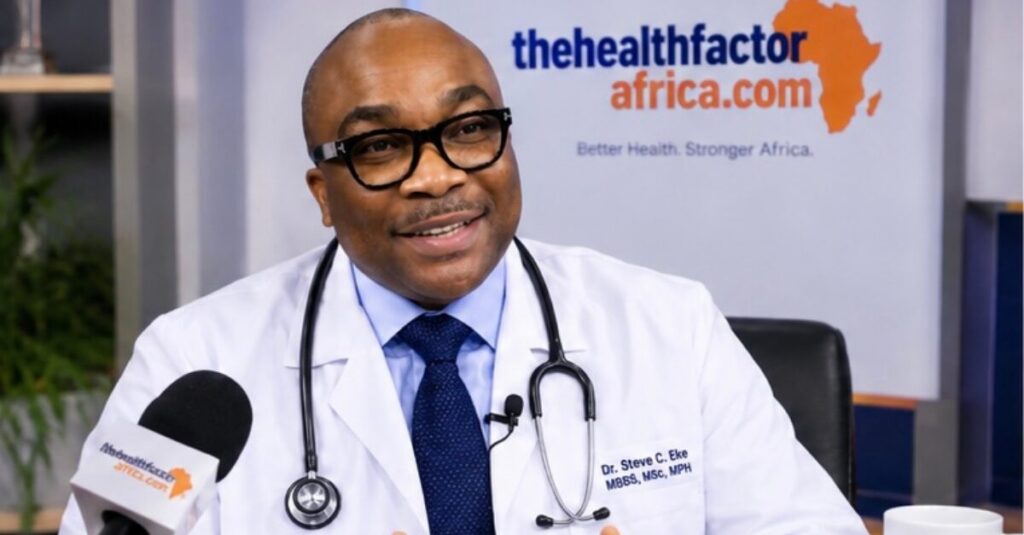
This is Part 1 of a three-part THF Africa series drawn from an exclusive interview with Dr. Steve C. Eke, a Nigerian-trained physician now practicing in the United States. Part 1 examines the diaspora-return debate. Part 2 looks at Nigeria’s health budget and infrastructure spending. Part 3 covers disease surveillance and epidemic preparedness.
On July 24, 2026, President Bola Ahmed Tinubu stood before a delegation of the Nigerian Diaspora Medical Associations Worldwide at the State House in Abuja and made a familiar appeal: come home. Reflecting on his own return to Nigeria after years working abroad with Deloitte and Mobil, the President told the visiting doctors that “there is nowhere like home,” framing their return as an extension of the oath they swore as medical professionals.
For Dr. Steve C. Eke, a physician who earned his MBBCh from the University of Calabar in 1999 and now serves as Clinic Director at UrgentCareTravel in the US, the appeal is well-intentioned but built on a false premise.
“As novel or noble as his appeal would be, I don’t see [patients in Nigeria] being able to afford those kinds of services at the level that they are,” he told THF Africa, reflecting on the economics of medicine in Nigeria versus the systems he now practices in. “You’re placing the Nigerian physician who is already situated, stable, running major budgets, either providing clinical services, insurance services, or administrative services, to leave all of that and come back to an uncertainty.”
A Trade, Not a Homecoming
Dr. Eke is careful to separate the emotional pull of home from the practical reality of what returning would mean. Uncertainty, he says, is a normal part of any risk, but this isn’t ordinary risk.
“You’re telling the physician who’s here, stable, already situated, practicing at the best of his ability, to leave all that for an uncertainty beyond just what you’re going to pay them,” he said. “You’re saying someone should leave what they have come to gather together as their preferred practice of medicine, to leave that and come to where there’s no light, no drugs, no oxygen. We’ve been there. It’s hard to do that.”
He doesn’t rule out diaspora doctors contributing to Nigeria’s health system entirely, but describes it in narrower terms than a full relocation. “We will eventually return. But it will always be on a pro bono, ‘what can we do’ level, not what our ability is able to.”
Infrastructure Before Invitation
Dr. Eke’s core argument is about sequencing. Before Nigeria asks its diaspora professionals to return, he says, it needs to rebuild the conditions that pushed them out in the first place, pointing to an era before the 1980s when Nigeria’s teaching hospitals drew patients from across the region, including from Saudi Arabia.
“For the president to ask for that, it’s him putting the cart before the horse,” he said. “You would have to first strengthen your teaching hospitals… return the healthcare structure to where we never heard of strikes from doctors or nurses, where people were paid salaries equivalent to their status in society, as and when due.”
He also draws a contrast with the generation of Nigerian doctors trained abroad, often in the UK, holding fellowships like FRCS or FRCP, who did return home after the country’s independence. “The reason they came back home was not because there were more people needing healthcare at home than in the UK,” he said. “It was because the people who trained them put a lot of emphasis on them coming back.” That expectation, he argues, was never matched with the institutional environment needed to sustain it. “I don’t think that ever happened.”
The Neurosurgeon Story
The conversation touched on a case that has drawn wide attention in Nigerian medical circles this year: Dr. Salamat Ahuoiza Aliu-Ibrahim, recognized as Nigeria’s first indigenously trained female neurosurgeon and West Africa’s first female certified neurosurgeon, who left her position as a senior consultant neurosurgeon at the University of Ilorin Teaching Hospital for the United States. After not matching into a US neurosurgery residency, she retrained and now practices as a pediatrician and medical director in Missouri.
Asked whether her story suggests Nigerian medical training doesn’t hold up internationally, Dr. Eke pushed back firmly. “Actually no, in fact the contrary is the answer. Everywhere here, African doctors perform extremely well above and beyond what is expected of them,” he said. The issue, he explained, is that licensure and specialty training don’t transfer automatically across systems, regardless of how skilled a physician already is. “If you’re not exposed to certain types of equipment, I don’t care how good you are with the theories of it, you’re not able to perform certain procedures. So the training is important,” he said, adding that her decision reflected the options in front of her, not a gap in her ability.
Accountability at the Top
Dr. Eke reserved some of his sharpest criticism for Nigeria’s political leadership, pointing to the pattern of senior officials, including presidents, vice presidents, and senate presidents, seeking medical treatment abroad while the domestic system they oversee goes underfunded.
“It’s an issue of questionable patriotism when the president has to go get treatment from another country,” he said. “And the funny part is, when they come outside, they come to the same Nigerian doctors who have been trained by the same country that they currently now lead.”
His closing message was less a policy prescription than a plea. “This is very important. My only prayer is that it gets to the right ears. That’s all.”
Dr. Eke holds an MBBCh from the University of Calabar, an MPH from Emory University’s Rollins School of Public Health, and an MSc in Medical and Translational Research from Kennesaw State University. This interview has been condensed and lightly edited for clarity.
Read the full series:
Part 1: You’re Asking Me to Trade Stability for Uncertainty (this article)
Part 2: Building Hospitals Isn’t Building Healthcare
Part 3: Surveillance Is the Key, Not Clinical Practice
The Health Factor Africa
Get verified health news, free
One email a week: explainers, myth-checks, and the stories behind the headlines.
Work in health policy, government or an NGO? Get the monthly Policy Brief instead.