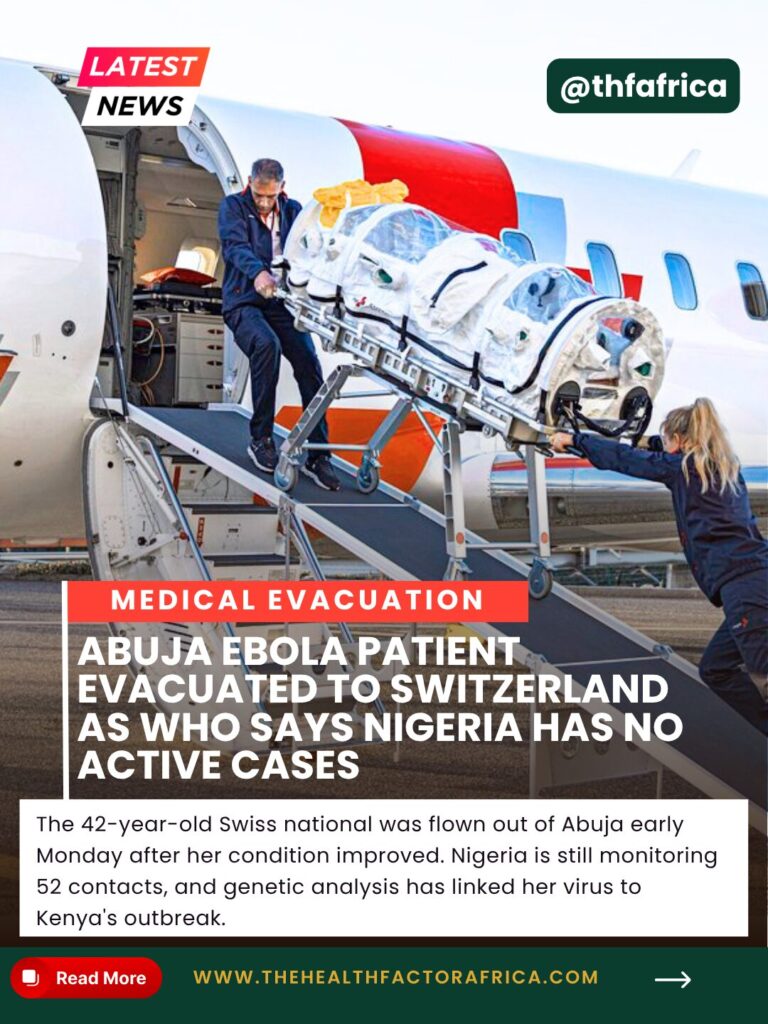
Nigeria’s first Ebola patient left the country early on Monday aboard a medical evacuation flight from the private jet terminal at Nnamdi Azikiwe International Airport, Abuja.
Health Minister Muhammad Ali Pate said the 42-year-old woman, a Swiss national married to a Swiss embassy employee, was evacuated with his approval and under strict public health protocols. He said she was stable, conscious and able to communicate, with lab results moving back toward normal. But he cautioned: “This does not mean she is not still infectious, hence the strict protocols in place.”
Her husband, who has shown no symptoms, travelled with her. Switzerland will take over her care and monitor him.
Nigeria’s status
“With the evacuation of the patient and her husband, Nigeria currently has no Ebola cases,” said Dr Mohamed Janabi, WHO Regional Director for Africa, who credited Nigerian medical teams with stabilising her through the acute phase.
That does not mean the outbreak response is over. Nigeria is still monitoring 52 contacts, mostly health workers, through the 21-day incubation window. NCDC had also reported two suspected cases on Sunday, and their results have not yet been announced. Pate urged Nigerians to stay vigilant.
A clue to the source
On Friday, Pate said genomic analysis showed her virus is “closely related to the strain detected in Kenya’s index case,” the first genetic link between the two outbreaks. Authorities said there is no evidence the Kenyan patient travelled to Nigeria or had any direct contact with her.
Where she was infected remains unresolved. Switzerland says she caught it in Uganda and never went to Congo. Uganda says it has had no cases since August.
If you develop fever, weakness, vomiting or diarrhoea after possible exposure, call NCDC on 6232. If the line does not connect, contact your state Ministry of Health or nearest government hospital by phone before going in person.
The Health Factor Africa
Get verified health news, free
One email a week: explainers, myth-checks, and the stories behind the headlines.
Work in health policy, government or an NGO? Get the monthly Policy Brief instead.