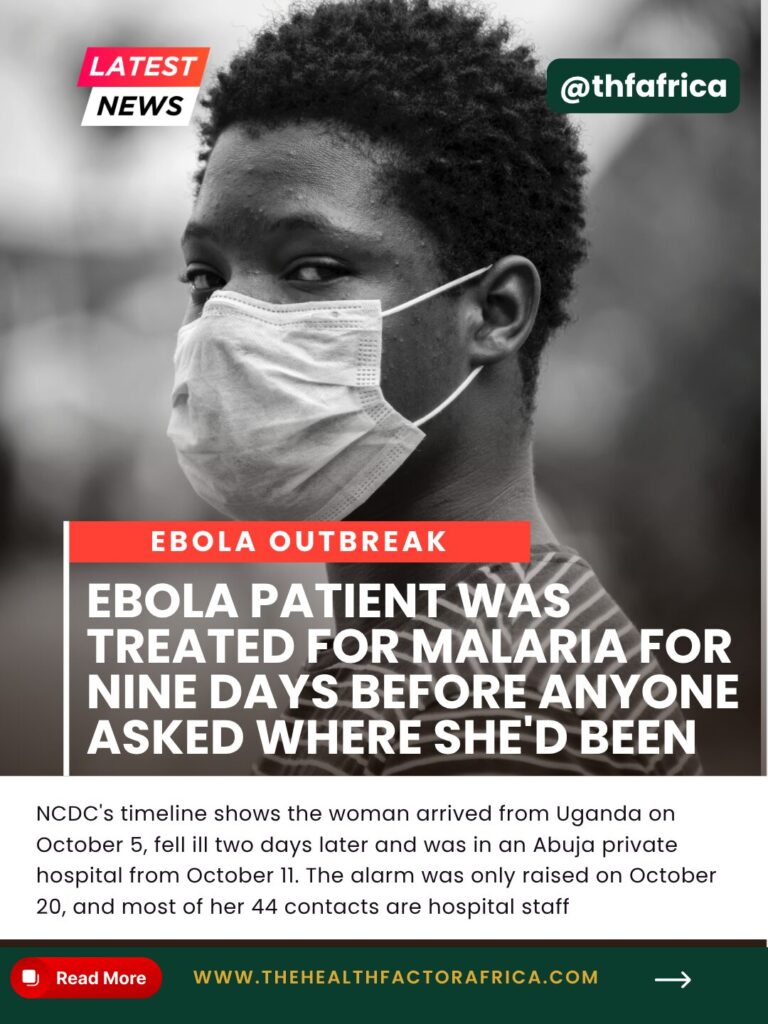
Fever, weakness, headache. In Nigeria, the first guess is almost always malaria. For nine days in an Abuja private hospital, that guess may have hidden Ebola.
New details from the Nigeria Centre for Disease Control and Prevention (NCDC) show how the country’s first imported Ebola case of this outbreak unfolded. Dr Odianosen Ehiakhamen, Incident Manager of the National Ebola Disease Response, laid out the timeline on Arise TV:
- October 5: The woman arrives in Nigeria after travelling from Uganda
- October 7: Symptoms begin
- October 11: She goes to a private facility in the FCT and is treated for malaria-like illness
- October 20: She fails to improve, doctors learn of her travel history, and the hospital alerts NCDC at about 4pm. Samples reach the lab by 9pm, and the case is confirmed the same day
“For the 44 contacts, they are majorly healthcare workers and support staff of the hospital,” Ehiakhamen said.
AllAfrica reports the strain as Bundibugyo, which drives the regional outbreak and has no approved vaccine or specific treatment. The US CDC counts at least 9,582 confirmed cases and 4,605 deaths across Central and East Africa.
The question that matters most
Nigeria’s 2014 Ebola case also began in a private hospital, where a traveller from Liberia was first treated before the diagnosis. Then, as now, health workers carried the greatest risk.
The lesson for every clinic: ask about travel. A single question at triage (“Have you travelled outside Nigeria in the last three weeks?”) can turn days of exposure into hours.
What the public should know
The Academy of Medical Sciences of Nigeria stresses that Ebola is not airborne and that a person cannot spread it before symptoms begin. It spreads through contact with the blood or body fluids of a sick person.
If you develop fever, severe weakness, vomiting or diarrhoea after possible exposure, avoid close contact with others and call NCDC’s toll-free line 6232, available 24/7, before going to a hospital.
The Health Factor Africa
Get Outbreak Watch in your inbox
New outbreaks, new data, sent the moment we publish.