On December 19, 2025, Nigeria signed a health agreement with the United States worth up to $5 billion, $2.1 billion of it American money, in about six weeks of negotiation. Four months later, Ghana looked at a similar deal and threw it out. President Mahama called its terms “humiliating”: Ghana’s medical records handed to Washington, incoming US medicines exempted from inspection by Ghana’s own drug regulator, and Ghana’s own funding required on top of it [Graphic.com.gh, 2026].
Nigerians still don’t know if any of those same provisions are sitting inside the agreement their own government signed. The Health Ministry released only a summary. The full MOU, its annexes, and the data-sharing terms have never been made public. Earlier drafts reportedly included language on “direct access to national databases” and pathogen data sharing running 25 years, but the public summary only vaguely references “information on long-term performance” [Nigeria Health Watch, 2026].
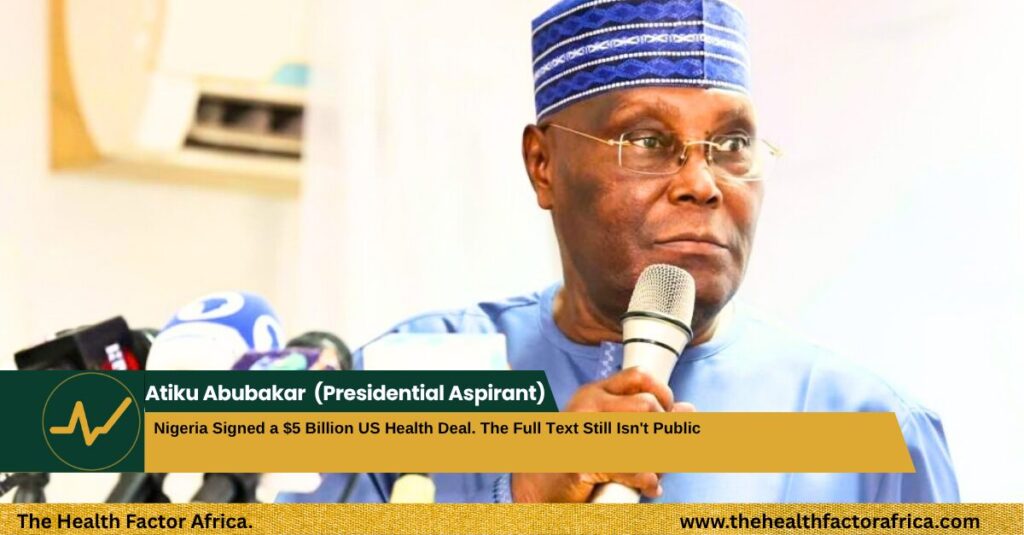
That gap is now a political flashpoint. ADC presidential candidate Atiku Abubakar is publicly demanding the government publish the complete MOU, all protocols and annexes, and the specific data and specimen-sharing terms, pointing out plainly that “Nigerians do not know whether the provisions Ghana rejected are in the agreement Tinubu signed” [ThisDay, 2026]. He’s also questioning whether Nigeria can even hold up its end, since only ₦36 million of a ₦218 billion 2025 health budget line was actually released toward the $3 billion Nigeria committed to co-fund.
There’s also a thread that has nothing to do with health at all. A US Embassy statement tied the MOU to Nigeria’s record on religiously motivated violence, language that reaches well past specimen sharing and vaccines.
Until the text is public, there’s no way to know what Nigeria actually agreed to, or what it gave up to get it.
The Health Factor Africa
Get verified health news, free
One email a week: explainers, myth-checks, and the stories behind the headlines.
Work in health policy, government or an NGO? Get the monthly Policy Brief instead.