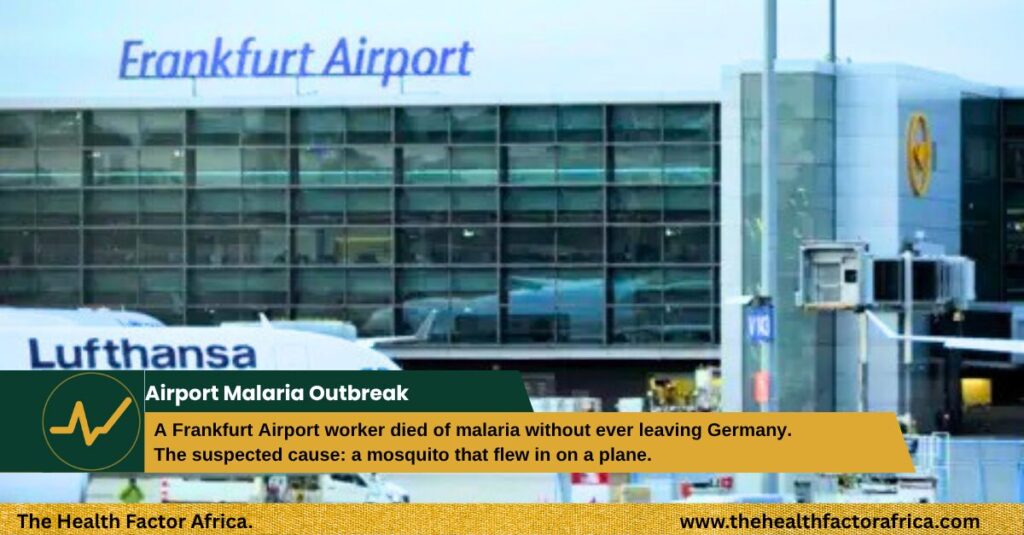
A Frankfurt Airport employee has died of malaria, and five colleagues are being treated, in a rare outbreak German authorities suspect began with a single infected mosquito that arrived by plane.
Airport operator Fraport and Germany’s Robert Koch Institute confirmed six cases total, two of them reported this week. Authorities believe an Anopheles mosquito, the species that transmits malaria, may have been unintentionally transported in an aircraft’s cargo hold from a malaria-endemic region, possibly as early as July, then bit workers at or around the airport. The RKI calls this “airport malaria,” a recognized but very rare transmission route. There’s no sign the disease is spreading person to person, and investigators are examining mosquitoes caught in traps set up around the facility.
The case has drawn particular attention in Nigeria, and it’s worth being precise about why. According to WHO, Nigeria accounted for roughly 27% of global malaria cases in 2022, the largest share of any single country, with an estimated 68.1 million cases and 184,700 deaths in 2023 alone. Ninety-five percent of the world’s malaria deaths occur in Africa. Against that backdrop, a handful of cases at a German airport isn’t a sign of new risk for Nigerians traveling to Germany, “airport malaria” remains extremely rare there, and it says nothing about malaria transmission changing anywhere in Africa. It’s a genuinely different story: a reminder that mosquitoes, not just people, can cross borders by air.
What You Can Do
• If you’re flying from a malaria-endemic region, this doesn’t change anything about your own risk, standard precautions (nets, repellent, prompt testing for fever) still apply where you actually live.
• If you develop fever, chills, or fatigue after any international flight, mention your travel history to a doctor regardless of your destination, malaria isn’t always where you’d expect it.
The Health Factor Africa
Get Outbreak Watch in your inbox
New outbreaks, new data, sent the moment we publish.