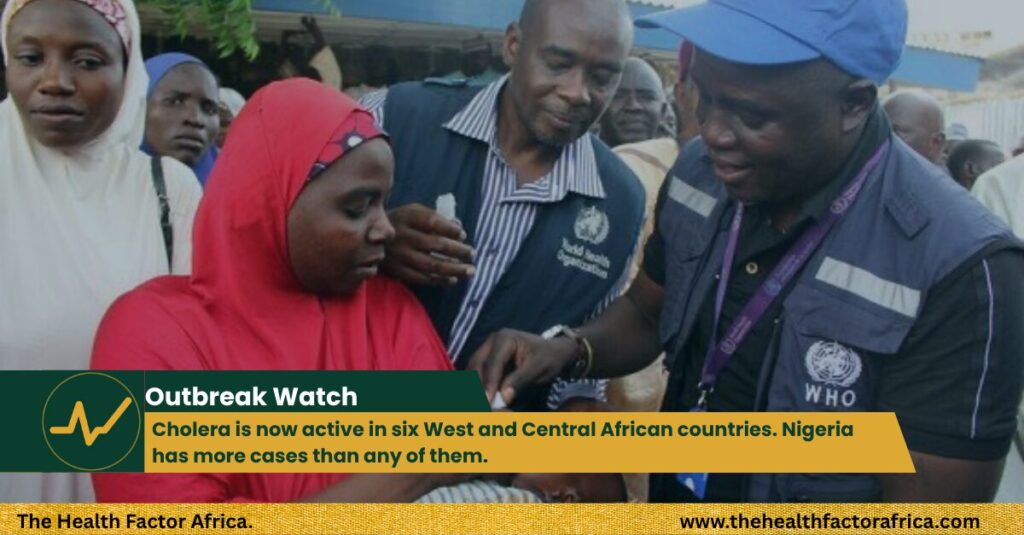
We’ve already covered the Ebola outbreak tearing through the Democratic Republic of Congo, now the fastest-growing in recorded history. That same country, and much of the region around it, is simultaneously dealing with a second, less-covered crisis moving along its rivers and trade routes: cholera. UNICEF says it’s now active in six countries across West and Central Africa, and Nigeria has the largest outbreak of anyone.
The Numbers
Nigeria has recorded more than 50,000 cumulative cholera cases and 338 deaths since January 1, 2026, the largest outbreak in the region, driven largely by a major outbreak in Borno State. The Democratic Republic of Congo has recorded the highest death toll of any affected country: nearly 700 deaths from more than 30,400 cases.
Two Rivers, Two Corridors
The outbreaks are following two distinct paths. Around the Lake Chad Basin, the same Vibrio cholerae O1 Ogawa strain is spreading across Chad, Cameroon, and Nigeria. Around the Congo River Basin, outbreaks are linking DRC, the Republic of Congo, and the Central African Republic. In both corridors, the pattern is the same: a shared water system connecting multiple countries, and a disease that doesn’t respect the borders drawn across it.
Why It’s Crossing Borders So Easily
Seasonal rains, flooding, population displacement, and ordinary cross-border movement are accelerating the spread. Flooding contaminates water sources directly, damages already-fragile sanitation infrastructure, and cuts off access to communities that need clean water most urgently right when they’re most exposed to contaminated supplies.
The Children Bearing the Worst of It
Cholera outbreaks rarely affect all age groups equally, and this one is hitting children especially hard. In the Central African Republic, children under 10 account for 44% of reported cases. In Chad, nearly two-thirds of infections are among children under 15. In Cameroon, the median age of patients is just 10 years old.
A Disease That Shouldn’t Still Be This Deadly
Here’s what makes this outbreak particularly frustrating from a public health standpoint: cholera is both preventable and treatable. It spreads through contaminated water and food, and it’s stopped by the same basic tools that have existed for decades, clean water, functioning sanitation, oral rehydration, and vaccination where needed. UNICEF Regional Director for West and Central Africa, Gilles Fagninou, put the core problem plainly: “this outbreak is no longer confined by borders.” Every new infection, he said, is a reminder that millions of children are still being denied access to safe water in the first place.
The Response
UNICEF and partner organizations are working with national and sub-national authorities to expand access to safe water and sanitation, strengthen disease surveillance, supply essential health materials, and support oral cholera vaccination campaigns. UNICEF is also coordinating with the World Health Organization and Africa CDC along the key transmission routes, and has called for $15 million in additional funding to scale up the response over the next six months.
What You Can Do
• If you’re in an affected area, especially Borno State or along the Lake Chad Basin, boil or treat drinking water when the source is uncertain, and seek care immediately at the first sign of severe watery diarrhoea. Cholera can kill within hours if untreated, but responds quickly to oral rehydration.
• Know the warning signs: sudden watery diarrhoea and vomiting are the key symptoms. Don’t wait to seek care, especially for children.
• Support water and sanitation infrastructure conversations in your community. This outbreak’s spread is fundamentally a water access story, not just a medical one.
• If you’re able to support relief efforts, UNICEF’s response in the region is currently underfunded relative to the scale of need.
The Health Factor Africa
Get Outbreak Watch in your inbox
New outbreaks, new data, sent the moment we publish.