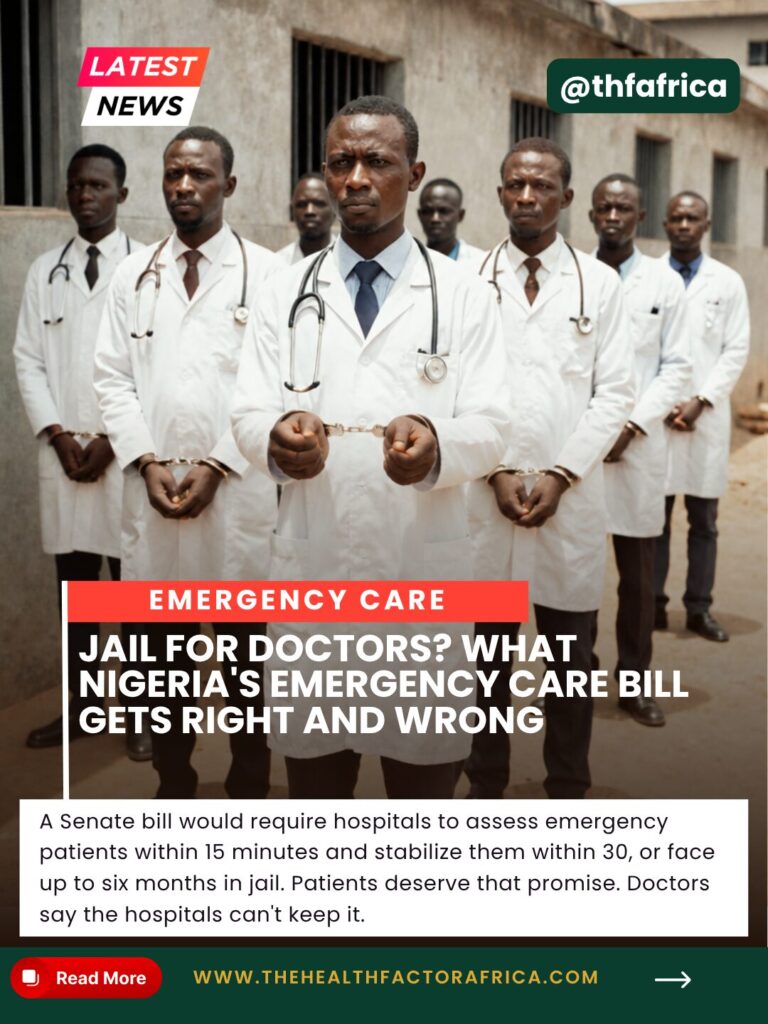
No Nigerian should die at a hospital gate because no one attended to them. That is the promise behind the National Health Act Amendment Bill 2026, sponsored by Senator Abdulaziz Musa Yar’Adua, which has passed second reading in the Senate.
What the bill says
- Initial assessment and triage within 15 minutes of arrival
- Basic stabilization within 30 minutes
- Admission within two hours, depending on bed availability, and transfers within three hours
- A fine of up to N300,000, six months in prison, or both for facilities or individuals who breach the rules
Refusing emergency treatment is already a crime. The 2014 National Health Act carries a N100,000 fine or six months in jail.
What it gets right
Families still report relatives being turned away, or asked for a deposit or a police report before treatment. A clear national standard tells patients what they are entitled to, and gives hospitals a benchmark they can be judged against.
What it gets wrong
The Nigerian Association of Resident Doctors (NARD) says it will consider “all lawful options, including nationwide industrial action” if the bill passes.
“You cannot legislate oxygen into an empty cylinder, electricity into a dark operating theatre,” the association said.
The numbers back them up. Health Minister Ali Pate says more than 16,000 doctors have left Nigeria in the last five to seven years. The country has about 3.9 doctors per 10,000 people, far below the global minimum. One doctor covering a crowded emergency ward cannot assess every patient in 15 minutes.
Delays often happen outside the doctor’s control: in the lab, the pharmacy or the blood bank, or because there’s no power. The Association of Nigeria Private Medical Practitioners notes that more than 90 percent of emergency patients don’t arrive by ambulance, so many are already critical when they reach the gate.
A better bill
The Senate says it will consult stakeholders before passing the bill. To work, it should:
- Hold facilities and their managers accountable for systems failures, not just the doctor on duty
- Fund emergency departments, ambulances and an emergency treatment fund, so no one is asked to pay first
- Count only refusals or neglect as offenses, not delays caused by shortages
Patients need a right to emergency care. Hospitals need the means to deliver it.
The Health Factor Africa
Get verified health news, free
One email a week: explainers, myth-checks, and the stories behind the headlines.
Work in health policy, government or an NGO? Get the monthly Policy Brief instead.