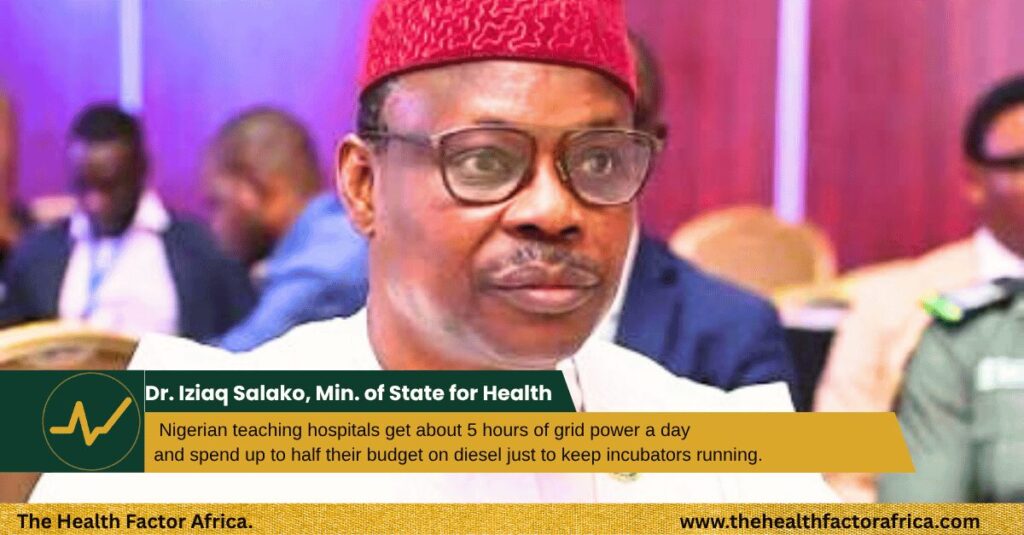
We’ve covered Nigeria’s lab capacity, its workforce shortage, its cancer infrastructure gaps. This week, Minister of State for Health Dr. Iziaq Salako named the problem underneath much of it: electricity.
Speaking at the launch of the Renewable Asset Management Company (RAMCO) in Abuja, Salako said between 60% and 70% of Nigeria’s primary and tertiary health facilities experience frequent power outages or have no electricity at all, and about 40% of functional Primary Health Care Centres have zero electricity access. Most remaining facilities get only six to ten hours of power a day. Teaching hospitals needing 3 to 8 megawatts for full operation receive roughly five hours of grid supply daily and can spend 40% to 50% of their operating budget on energy, mostly diesel. Salako, speaking as a physician, framed electricity not as infrastructure but as a clinical input, powering vaccine cold chains, oxygen concentrators, operating theatres, and neonatal incubators directly.
Nigeria has tried to fix this before. Under existing programmes, 100 health facilities received 50-kilowatt solar hybrid systems, with a second phase targeting 400 more. But Salako revealed a striking failure rate: more than 30% of solar systems installed in Primary Health Care Centres become non-functional within three years, not because the technology fails, but because of poor maintenance, unavailable spare parts, and no clear ownership of the equipment once a project ends.
That’s what RAMCO is meant to solve, an asset-management model built to professionally maintain renewable infrastructure long-term rather than treat installation as the finish line. The government’s target: steady power in at least 30% of health facilities by the end of 2027, backed by a formal Compact signed in 2025 between health and power ministries, states, hospital directors, and private investors.
What You Can Do
- If you work at a health facility with a failed or failing solar system, this is now a named, government-acknowledged problem, worth escalating through your facility’s energy audit process rather than treating as unfixable.
- Watch the 2027 target closely. Thirty percent is a modest goal against a 60-70% outage rate, worth tracking whether it’s actually met.
This article is for general information based on an official government statement. For facility-specific energy programme details, contact the Federal Ministry of Health and Social Welfare.
The Health Factor Africa
Want the Policy Brief version?
Every explainer gets a shorter, policy-focused brief in your inbox — built for people who need the decision-relevant version fast.