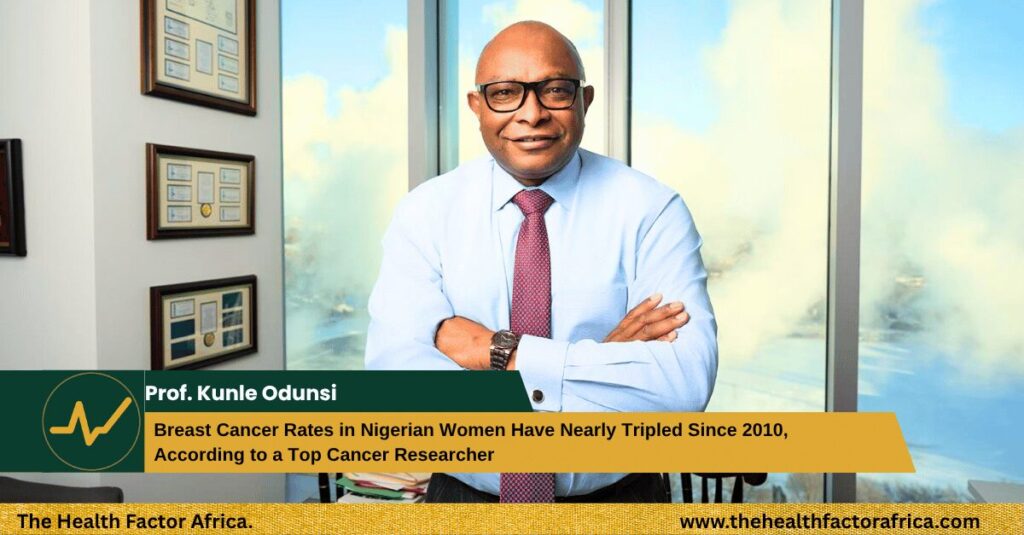
Prof. Kunle Odunsi, Director of the University of Chicago Medicine Comprehensive Cancer Center, told an Abuja audience this year that breast cancer incidence among Nigerian women rose 245% between 2010 and 2022, from 54.3 to 133.3 cases per 100,000. He shared the figure during a public lecture hosted by the Nigerian Academy of Science, where he was inducted as a Fellow, titled “Redefining Cancer Care in the Era of Immunotherapy and Precision Oncology.”
That number sits inside a broader warning. Odunsi told the same audience that roughly one in four people globally will develop cancer in their lifetime, and that Nigeria’s cancer care system isn’t built for the burden it already carries. The more urgent detail may be this: he said no fewer than 80% of breast cancer cases in Nigeria are diagnosed at stage three or four, compared with under 10% in wealthier countries. Late diagnosis, not just rising incidence, is what’s actually driving Nigeria’s poor outcomes.
The infrastructure gap behind that statistic is stark. Odunsi noted Nigeria has only around 10 radiation therapy centres nationwide, grossly inadequate for the country’s population, and that standard treatment remains unaffordable for many patients even where facilities exist.
His proposed response centres on two shifts: a national cancer registry to identify Nigeria-specific genetic risk factors and track disease patterns properly, and expanded screening specifically for breast and colorectal cancers, where late-stage presentation is most common. Longer term, he argued for wider adoption of precision oncology, using a patient’s genetic and molecular profile to guide treatment instead of standard chemotherapy alone, and immunotherapy, which retrains the immune system to target cancer cells directly.
This adds to a pattern we’ve traced before: Nigeria’s National Cancer Health Fund currently excludes several cancer types, and the country has zero liver transplant capacity for hepatobiliary cancer patients. The infrastructure gaps keep showing up regardless of which cancer type is being discussed.
What You Can Do
- Don’t wait for symptoms to become visible or painful. Late-stage presentation, not the disease itself, is the biggest driver of poor breast cancer outcomes in Nigeria.
- Ask about screening options at your nearest facility, even without a family history; most Nigerian patients are diagnosed well after the disease has spread.
- Support calls for a national cancer registry. Better population-level data is what would let Nigeria target screening and treatment where they’re actually needed most.
This article is for general health education and does not replace professional medical advice. If you notice any changes in your breast health, please consult a qualified health worker promptly.
The Health Factor Africa
Want the Policy Brief version?
Every explainer gets a shorter, policy-focused brief in your inbox — built for people who need the decision-relevant version fast.