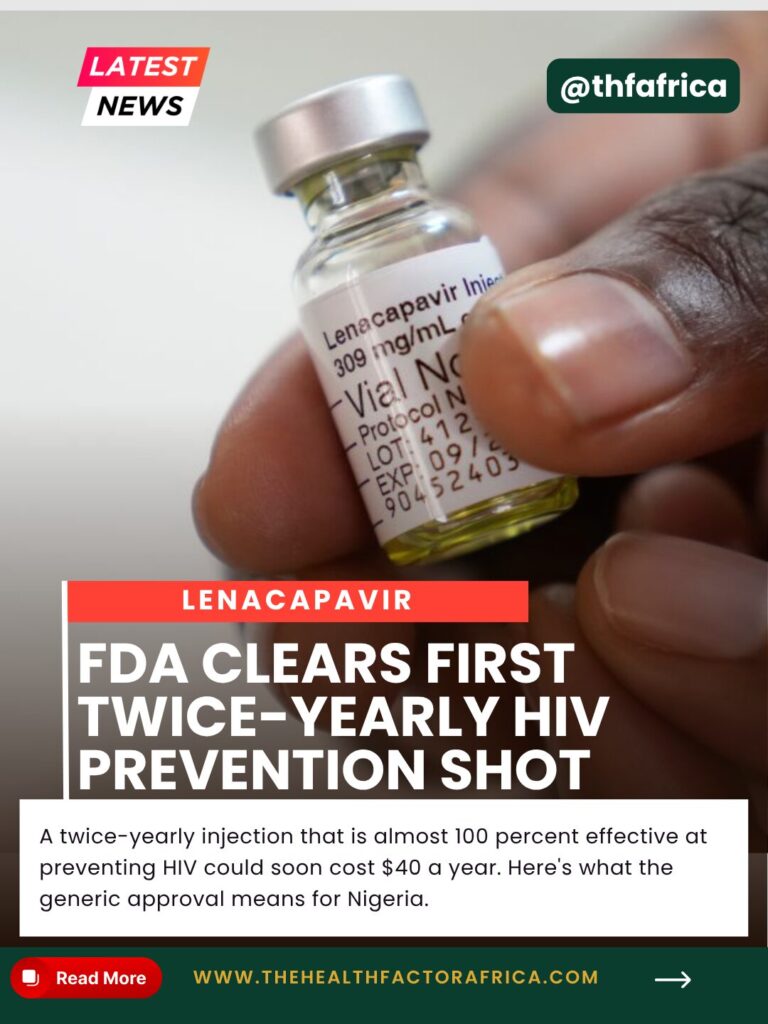
The US Food and Drug Administration (FDA) has given tentative approval to the first generic version of lenacapavir, the twice-yearly injection that prevents HIV.
India’s Dr Reddy’s Laboratories makes the generic, which is expected to cost about $40 per person per year. It will be sold in 120 low- and middle-income countries covered by a voluntary license from Gilead, the drug’s original maker.
Tentative approval is the FDA’s standard step for a generic while the original drug is still under patent. It means the product meets US standards and can be bought with US government funds. The first supplies should reach countries by the end of 2026, with wider availability in 2027.
“Two injections a year, of a product that is almost 100% effective at preventing HIV, changes that entirely,” said Neil Buddy Shah, CEO of the Clinton Health Access Initiative (CHAI). More than 125,000 people in Africa have already started on lenacapavir, he said.
Unitaid, CHAI and South Africa’s Wits RHI backed the generic’s development.
Where Nigeria stands
Nigeria is one of nine early adopters of lenacapavir. The National Agency for the Control of AIDS (NACA) began rolling out the branded injection this year in the FCT and eight states: Anambra, Ebonyi, Gombe, Kwara, Akwa Ibom, Cross River and Benue. It is for HIV-negative people at substantial risk of infection.
“It is not a treatment. It is a prevention,” NACA officials said.
Early doses came from donors, and supply has been limited. At $40 a year, Nigeria could reach far more people. Doing so will need steady funding, especially with the Global Fund $5.3 billion short of its target.
“An affordable generic is not enough,” warned Saiqa Mullick of Wits RHI. Clinics, health workers and communities have to be ready too.
Lenacapavir does not protect against other sexually transmitted infections or pregnancy.
The Health Factor Africa
Get verified health news, free
One email a week: explainers, myth-checks, and the stories behind the headlines.
Work in health policy, government or an NGO? Get the monthly Policy Brief instead.