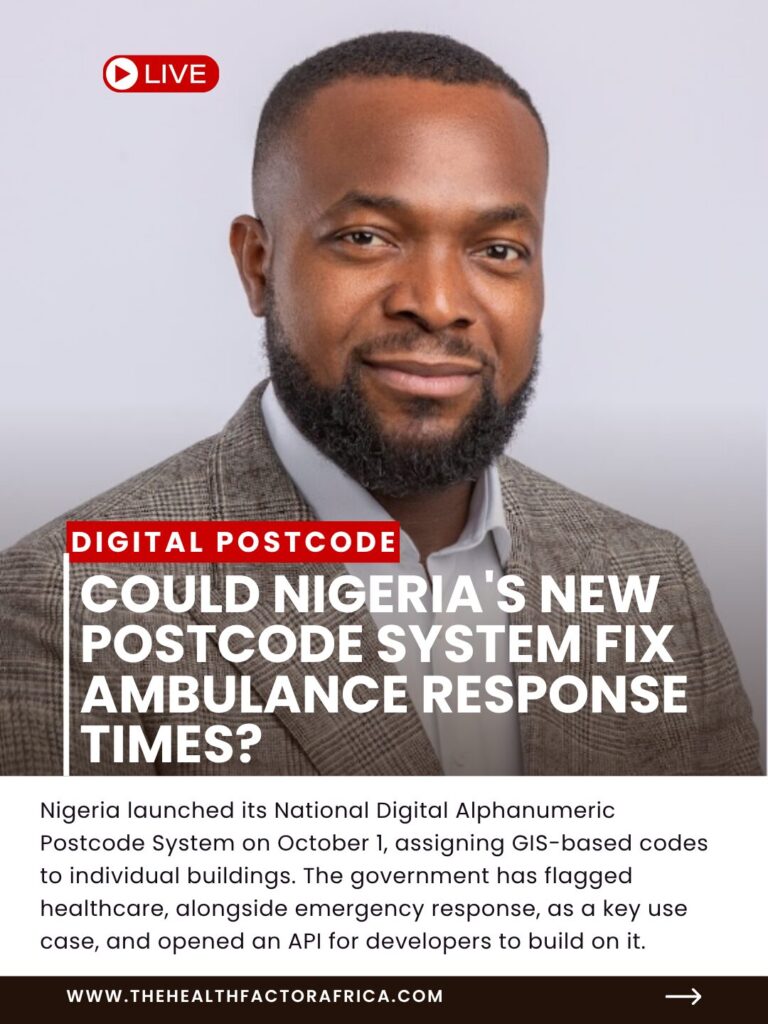
“Turn left after the big mango tree, the house with the blue gate.” That is how a lot of Nigerian addresses still work, and it is a real problem when an ambulance is trying to find you.
On October 1, the Federal Government launched the National Digital Alphanumeric Postcode System, giving individual buildings, not just neighborhoods, an 11-character GIS-enabled code tied to precise coordinates [Nairametrics, TheCable, 2026]. NIPOST runs the platform, and the policy behind it was approved by the Federal Executive Council back in March [Nairametrics, 2026]. Minister of Communications, Innovation and Digital Economy Bosun Tijani called it a step toward a Nigeria where location connects people to more services [Bantu Gazette, 2026
Healthcare is one of the sectors officials have explicitly named. Alongside commerce, transportation, agriculture and emergency response, the government is pointing developers toward the postcode system as infrastructure to build on, and has opened an API for organizations that complete know-your-business verification [TechAfrica News, 2026]. At a June workshop in Abuja, security and emergency agencies specifically discussed using the postcode as a shared framework for coordinating responses and verifying locations [TechLabari, 2026]. In theory, that is the difference between a dispatcher guessing at a landmark and an ambulance driver typing in a code that pins the exact building.
Whether that promise holds depends on adoption nobody can mandate. Citizens generate their own codes through NIPOST’s website, an app or USSD, and nationwide coverage is targeted for December [TechLabari, 2026]. A postcode only helps a health worker find a patient if the patient, the clinic and the dispatch system are all using it. For now, the system is live and the health use case is still a stated ambition, not a built product.
The Health Factor Africa
Get verified health news, free
One email a week: explainers, myth-checks, and the stories behind the headlines.
Work in health policy, government or an NGO? Get the monthly Policy Brief instead.