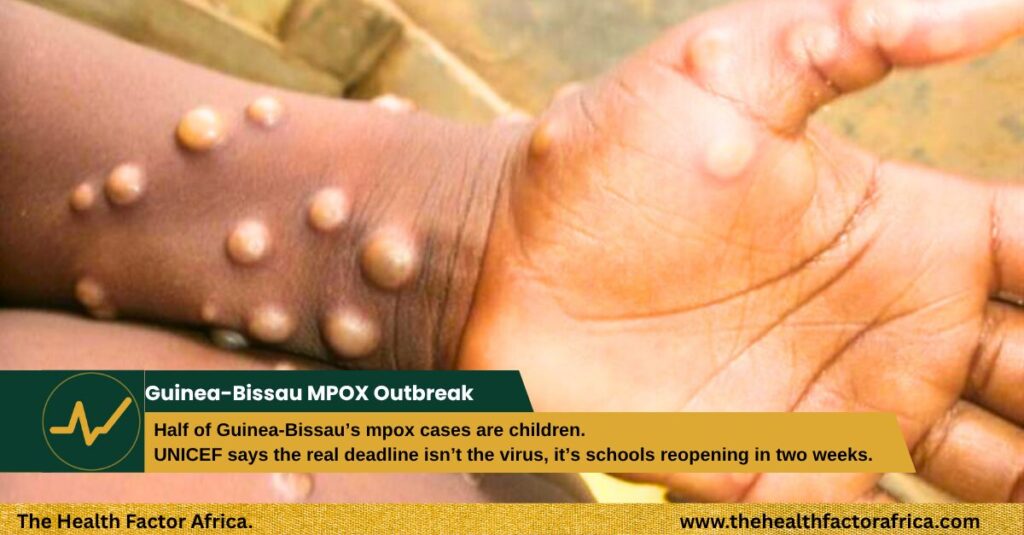
Guinea-Bissau is facing its first-ever mpox outbreak, and children are bearing most of it. Half of the 46 suspected cases recorded so far are children, UNICEF says, including 16 under the age of four. Seven confirmed cases among adults have been recorded, with no deaths, since the government declared the outbreak on July 4.
UNICEF Deputy Representative Sandra Martins flagged a specific, urgent concern: schools reopening in September, combined with existing gaps in surveillance, could widen the outbreak’s reach among the country’s youngest and most vulnerable residents. Newborns and young children face higher risk of severe mpox than adults, and while most cases resolve on their own, doctors point to the 2022 international outbreak, where many fatalities involved children or people with underlying health conditions, as a reason not to be complacent.
This is a small piece of a much larger continental picture. WHO declared mpox a Public Health Emergency of International Concern in August 2024 after a more severe strain, clade Ib, emerged in DRC and spread regionally. Between January 2025 and mid-March 2026, 30 African countries logged more than 46,000 confirmed cases, with Madagascar, DRC, Guinea, Kenya, and Burundi among the hardest hit. Continental case counts have trended downward since a mid-2025 peak, but WHO cautions the true scale may be underestimated where surveillance has been scaled back or diverted to other emergencies, the same pattern we’ve traced in DRC’s Ebola response this year.
Notably, mpox in these African outbreaks spreads through everyday close-contact routes, skin-to-skin contact, shared clothing or bedding, contaminated utensils, unlike the 2022 global wave concentrated among adults with multiple sexual partners. That’s precisely why households and schools are the real risk points here. UNICEF says it needs more than $150,000 in flexible emergency funding to sustain surveillance, contact tracing, and community outreach before classrooms reopen.
What You Can Do
• If you’re a parent in Guinea-Bissau or a neighbouring country, seek care immediately if a child develops a rash, fever, or swollen lymph nodes, don’t wait for symptoms to worsen.
• Don’t share clothing, bedding, or eating utensils with anyone showing symptoms, and isolate infected household members where possible until lesions fully heal.
• Push back on stigma around mpox. UNICEF specifically notes fear of social exclusion delays families from seeking care, which lets the virus spread further before it’s caught.
The Health Factor Africa
Get Outbreak Watch in your inbox
New outbreaks, new data, sent the moment we publish.