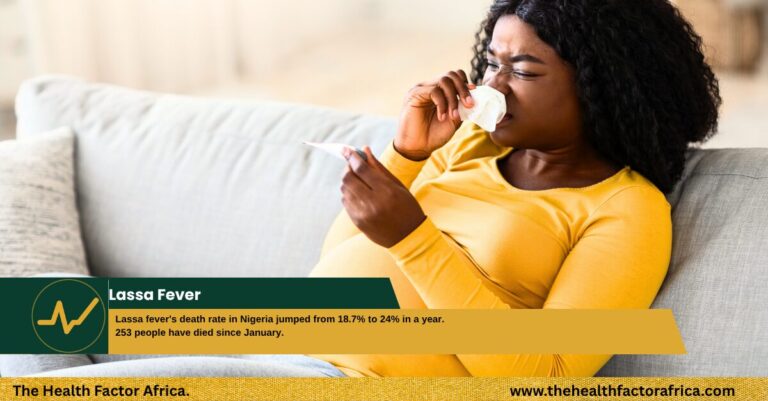
Nigeria has recorded 229 deaths from Lassa fever this year. It is a grim number, and it will lead most of the headlines. But it is not the number that should worry us most.
The number that should worry us is 23.8 per cent.
That is the case fatality rate — the share of people with a laboratory-confirmed Lassa infection who did not survive it. At the same point in 2025, that figure stood at 18.7 per cent. In the space of a single year, the disease has become measurably more lethal to the people who catch it.
That shift is not about the virus. It is about us.
What the latest report actually says
The Nigeria Centre for Disease Control and Prevention released its Lassa fever situation report for epidemiological week 28 on Friday, 24 July. As of that week, Nigeria had recorded 963 laboratory-confirmed cases out of 6,554 suspected cases, and 229 deaths.
New infections have not settled into a clean downward trend. Confirmed cases fell from 31 in week 26 to 14 in week 27, then climbed back to 25 in week 28. The week 28 cases came from Ondo, Bauchi, Edo, Kogi and Cross River states. The week before, they came from Ondo, Edo, Benue, Bauchi and Kogi.
Twenty-three states have now recorded at least one confirmed case, spread across 114 local government areas — up from 113 the previous week. But the burden remains heavily concentrated. Five states account for 86 per cent of all confirmed infections: Ondo leads with 31 per cent, followed by Bauchi at 25 per cent, Taraba at 14 per cent, Edo at 10 per cent and Benue at 6 per cent.
For comparison, at the same point in 2025 Nigeria had recorded 790 confirmed cases and 148 deaths. This year: 963 cases and 229 deaths. More people are catching it, and a larger share of them are dying.
Why a rising fatality rate is different from a rising case count
A rising case count can mean many things. It can mean better surveillance. It can mean more testing. It can even, perversely, be a sign that a system is working — that cases which once went unrecorded are now being found.
A rising fatality rate means something narrower and harder. It means that among people confirmed to have the disease, a larger proportion is dying. Lassa fever is treatable. The antiviral ribavirin works considerably better when it is given early. Supportive care in a properly equipped treatment centre saves lives. When the death rate climbs, the most likely explanations are about timing and access, not about the pathogen.
The NCDC has been explicit about the obstacles it faces. Among the challenges the agency has identified this year: patients presenting late, poor health-seeking behaviour driven by the cost of treatment, inadequate environmental sanitation in affected communities, and insecurity limiting response in parts of the country.
Read that list again. Every item on it is a systems problem, not a virology problem.
Someone in a rural community in Taraba who develops fever, weakness and headache in week one and reaches a treatment centre in week three is a very different clinical case from someone who reaches it in week one. The virus is identical. The outcome is not.
Who is being affected
The most affected age group this year is people between 21 and 30 — working-age adults, many of them the primary earners in their households. This is not a disease concentrated among the very old or the very young. It is taking people at the point in their lives when families depend on them most.
Health workers remain exposed. One healthcare worker was infected during week 28; none were infected the week before. Across the first half of 2026, 50 healthcare workers had contracted the disease. Nigeria cannot afford to lose clinicians in a country that already has too few of them, and every infected health worker represents a facility where early recognition or infection control fell short.
In June, a senior doctor working with the APIN Foundation in Konshisha Local Government Area of Benue State died after battling the illness for more than two weeks. He was buried on 20 June. Benue’s health commissioner confirmed the case at a moment when the state had been preparing to declare itself free of Lassa fever.
The seasonal question
Lassa fever in Nigeria has a rhythm. It arrives with the harmattan, roughly between November and April, when dry conditions push the multimammate rat — Mastomys natalensis, the animal reservoir — out of the bush and into homes, kitchens and grain stores. That is when Nigeria braces.
It is now late July. Cases rose in the most recent reporting week. Whatever the eventual explanation, a transmission pattern that no longer respects the calendar is a pattern that public health planning has to account for. A response system that mobilises in November and stands down in May is a system built for a disease that may be changing its habits.
What this means for your household
The practical guidance has not changed, and it works.
• Store food in sealed containers. Rats contaminate grain, garri and dried foods with urine and droppings. This is the single most common route of infection.
• Keep the compound clean. Dispose of refuse properly and away from the house. Block holes and entry points. Do not leave food waste in the open.
• Do not handle rats, and do not eat them. In some communities rodents are a food source. Catching, preparing and eating them is a direct exposure route.
• Go early. This is the one that matters most. Persistent fever that does not respond to malaria treatment, unusual weakness, severe headache, sore throat, or any unexplained bleeding warrants immediate medical attention. Tell the clinician you are concerned about Lassa fever. Early is survivable. Late is often not.
• Report suspected cases. The NCDC operates a toll-free line: 6232.
The bottom line
Two hundred and twenty-nine Nigerians have died of a disease we know how to diagnose and know how to treat. The outbreak is not new, the affected states are not a surprise, and the seasonal pattern has been documented for decades.
What has changed is the share of infected people who do not survive. That figure is a measure of how quickly a sick person in Ondo or Bauchi or Taraba can reach care they can afford, delivered by staff equipped to recognise what they are looking at.
Until that number comes down, the death toll will keep climbing — predictably, and preventably
The Health Factor Africa
Get Outbreak Watch in your inbox
New outbreaks, new data, sent the moment we publish.